Tuesday, May 1, 2012

SPD's APRIL POETRY BEST-SELLERS
- Heath Course Pak by Tan Lin (Counterpath Press)
- I Am Your Slave Now Do What I Say by Anthony Madrid (Canarium Books)
- My Lorenzo by Sébastien Smirou (translated by Andrew Zawacki) (Burning Deck)
- Meat Heart by Melissa Broder (Publishing Genius Press)
- Fjords Vol.1 by Zachary Schomburg (Black Ocean)
- My Love Is a Dead Arctic Explorer by Paige Ackerson-Kiely (Ahsahta Press)
- Western Practice by Stephen Motika (Alice James Books)
- Alpha Donut by Matvei Yankelevich (United Artists Books)
- The Hartford Book by Samuel Amadon (Cleveland State University Poetry Center)
- Conversities by Srikanth Reddy and Dan Beachy-Quick (1913 Press)
- Beauty Was the Case that They Gave Me by Mark Leidner (Factory Hollow Press)
- Blue Orange by Robert Grunst (Ashland Poetry Press)
- The Malady of the Century by Jon Leon (Futurepoem Books)
- Diego Luna's Insider Tips by Renato Rosaldo (Many Mountains Moving Press)
- For the Living and the Dead by Tomas Tranströmer (translated by John F. Deane) (Tavern Books)
- Baltics by Tomas Tranströmer (translated by Samuel Charters) (Tavern Books)
- Uselysses by Noel Black (Ugly Duckling Presse)
- Repeat the Flesh in Numbers by Kris Bigalk (NYQ Books)
- I Take Back the Sponge Cake: A Lyrical Choose-Your-Own-Adventure by Loren Erdrich and Sierra Nelson (Rose Metal Press)
- Transit by Geoffrey Movius (Pressed Wafer)
Friday, April 20, 2012
Wednesday, April 11, 2012
kate schapira at rhode island historical society 4/25/12
| How We Saved the City |
Wednesday, April 25th
6:30-8:00 pm
Rhode Island Historical Society Library
121 Hope St., Providence
Kate Schapira will read from her book of poems, How We Saved the City, which asks: Who decides what a city and its people need? Who creates its history, and how?
Come learn more about gentrification, ghosts, and concurrent and successive cities in Schapira's chosen home of Providence.
Kate Schapira is the author of three full-length books and six chapbooks of poetry. She co-organizes the Publicly Complex Reading Series at Ada Books and teaches writing at Brown University.
Kate Schapira is the author of three full-length books and six chapbooks of poetry. She co-organizes the Publicly Complex Reading Series at Ada Books and teaches writing at Brown University.
This event is free and open to the public.
Friday, April 6, 2012

Thursday, March 15, 2012
Granoff Spring Festival
I am a member of the Student Creative Arts Council and we are currently looking for submissions for the Spring
Arts Festival that will take place in the Granoff Center on April 27th
and 28th. After seeing your work on display at the Granoff, I thought
you might be interested.
The Student Creative Arts Council is looking for submissions of 2D, 3D, music, video, and/or performance pieces to be performed, shown or created at the annual Spring Arts Festival
The Spring Arts Festival is a celebration of the enormous creative efforts and capabilities of the Brown University Community. The two-day event will feature installations, performances, screenings, and lectures, and aims to promote the diverse forms of art generated and inspired here on campus.
The deadline for submissions is March 13th, 2012.
To submit, please send an e-mail to studentcreativearts@gmail.com with the following information:
1. Name/Year:
2. Project Description:
3. Medium:
4. Dimensions:
5. Facility/Tech/Installation needs:
6. Photos/Videos of the project (if possible)
Best,
Elizabeth Woodward
The Student Creative Arts Council is looking for submissions of 2D, 3D, music, video, and/or performance pieces to be performed, shown or created at the annual Spring Arts Festival
The Spring Arts Festival is a celebration of the enormous creative efforts and capabilities of the Brown University Community. The two-day event will feature installations, performances, screenings, and lectures, and aims to promote the diverse forms of art generated and inspired here on campus.
The deadline for submissions is March 13th, 2012.
To submit, please send an e-mail to studentcreativearts@gmail.com with the following information:
1. Name/Year:
2. Project Description:
3. Medium:
4. Dimensions:
5. Facility/Tech/Installation needs:
6. Photos/Videos of the project (if possible)
Best,
Elizabeth Woodward
Monday, March 12, 2012
Keats' + his referents
 |
| William Shakespeare, April 26, 1564-April 23, 1616 |
 |
John Milton, December 9, 1608-November 8, 1674
|
 | ||
Robert Burns, January 25, 1759-July 21, 1796
.jpg) |

 | ||
Gordon, Lord Byron, January 22, 1788-April 19, 1824
|


Sunday, March 11, 2012
Saturday, March 10, 2012
Mysteries of the Vernacular
http://www.mysteriesofvernacular.com/

Not strictly poetry, but click on the link if you are someone who loves words and etymology!
Jessica Orek is usually a documentary filmmaker, but she decided to take a break and create a series of short animations (26, one for each English letter) that explore the history and mystery of the vernacular. There's only one episode so far, but it's really great so keep an eye out for updates to the project!
Thursday, March 8, 2012
from A Book of Hours
Beside a stream a man
is reading. He sits against a
tree, one knee drawn up as support
for his book. Next to him a
long slender pole is propped; a line dangles into the water.
The open pages of the
book show an illustrated, gilded scene: a tiny figure by a stream, fields
giving onto a town beyond. In the
fields, men and women bend over curved bundles of wheat. Their scythes make dark punctuations of
the harvest.
The man smiles, as if
pleased with what he sees. Then he
yawns and looks over at
the pole. He shifts his gaze
a bit and considers the prospect of the town in the distance:
the familiar spires and gables.
He surveys the fields, before returning to the book.
A shadowiness comes
over the surrounding landscape, as if a cloud were passing in front of the
sun. It is the man’s hand, about
to turn the page.
Barry Yourgrau
Tuesday, March 6, 2012


Wednesday, February 29, 2012
In My Craft or Sullen Art
In my craft or sullen art
Exercised in the still night
When only the moon rages
And the lovers lie abed
With all their griefs in their arms,
I labor by singing light
Not for ambition or bread
Or the strut and trade of charms
On the ivory stages
But for the common wages
Of their most secret heart.
Not for the proud man apart
From the raging moon I write
On these spindrift pages
Nor for the towering dead
With their nightingales and psalms
But for the lovers, their arms
Round the griefs of the ages,
Who pay no praise or wages
Nor heed my craft or art.
Dylan Thomas, 1957
Exercised in the still night
When only the moon rages
And the lovers lie abed
With all their griefs in their arms,
I labor by singing light
Not for ambition or bread
Or the strut and trade of charms
On the ivory stages
But for the common wages
Of their most secret heart.
Not for the proud man apart
From the raging moon I write
On these spindrift pages
Nor for the towering dead
With their nightingales and psalms
But for the lovers, their arms
Round the griefs of the ages,
Who pay no praise or wages
Nor heed my craft or art.
Dylan Thomas, 1957
Sunday, January 15, 2012
Monday, May 23, 2011
PROJECTION


two projectors on opposite sides of the room projecting onto a translucent screen.
one projecting white light, the other projecting white text.
the viewer can only read the text in their silhouette (when standing in front of the white light), or on their body (standing in front of the projector with text).
the whole text can never be all read at once and with no interaction it appears a blank screen.
sobakasukasu
Hey y'all,
Unlike my last publishing attempt (----> http://www.inviewoutoffocus.blogspot.com, if you're interested), you can actually read my poems (new 'n old) now.
sobakasukasu
'sobakasu' means freckles
'kasu' means crumbs
Unlike my last publishing attempt (----> http://www.inviewoutoffocus.blogspot.com, if you're interested), you can actually read my poems (new 'n old) now.
sobakasukasu
'sobakasu' means freckles
'kasu' means crumbs
Monday, May 9, 2011
Freckles
*Disclaimer: I think freckles are lovely and I certainly love mine!
If freckles were lovely
If freckles were lovely, and day was night,
And measles were nice and a lie warn't a lie,
Life would be delight,--
But things couldn't go right
For in such a sad plight
I wouldn't be I.
If earth was heaven and now was hence,
And past was present, and false was true,
There might be some sense
But I'd be in suspense
For on such a pretense
You wouldn't be you.
If fear was plucky, and globes were square,
And dirt was cleanly and tears were glee
Things would seem fair,--
Yet they'd all despair,
For if here was there
We wouldn't be we.
And measles were nice and a lie warn't a lie,
Life would be delight,--
But things couldn't go right
For in such a sad plight
I wouldn't be I.
If earth was heaven and now was hence,
And past was present, and false was true,
There might be some sense
But I'd be in suspense
For on such a pretense
You wouldn't be you.
If fear was plucky, and globes were square,
And dirt was cleanly and tears were glee
Things would seem fair,--
Yet they'd all despair,
For if here was there
We wouldn't be we.
- e.e. cummings
Saturday, April 30, 2011
Tuesday, April 26, 2011
Proposal for the New Humans
1
Do not
anthropomorphize
animals
nor
objects
2
Always
question
your raison d'être
do you really
need to
exist?
3
Keep emptying
to full-fill
your emptiness
4
Decountralize
in order to
destroy
our ready-made
196 countries
frontiers
militaries
wars
conflicts
tensions
...
even the great wall
of China cannot divide
the continents
as we
are all under the
same sky
5
Get rid
of the word
peace,
in order to
get rid
of the word
war
as
if there are no questions
then
there are no answers
6
Terminate your
social security numbers
official paper documents
and all the encoded
numbers
embedded in your body
7
Screw powerful utilities,
large corporations,
and all those lunatics
never stop
fighting
against their
authoritarian
tendencies
8
The infinity
that we've been
taught
only comes
from the brain
of the mathematicians
and physicians
∴
the infinity
that we know of
is a false
9
Stop following
the set of rules
the authoritarians
have assigned for us
and
start making
your own
0
Beware
the return
of the repressed
- - -
This was my new poem for today.
Let's have fun tomorrow.
!
A Statement of Poetics
I often collect words and place them in my handbag
Later, I organize my lip balms and hand lotions
Later, after I have put my lip balms and hand lotions in good order, I organize my words
I put them in an order that seems most poetical to me
I line them up and if I am very lucky they will tell me a poem
If they are feeling ill and have gone out smoking the night before, their voices will be scratchy
For the most part I do not appreciate their scratchy voices and ask them to refrain from smoking
On occasion, I will smoke as well, and then I do not so much mind the scratchiness of their voices
On occasion, I enjoy this scratchiness so much that I will ask a word to repeat itself
Sometimes, flattery is not a good idea for a word
Sometimes he will become arrogant and condescending and puff out his chest as though he has just won a horse-race
I detest horse-races
I am not sure that I detest anything else quite so much as horse-races
I am sure, however, that I do not enjoy insincerity
On occasion, a word will lie to me
I am a gentle person and react quite reasonably
I swear and curse and rage and threaten to throw it out on the streets
But, owing to my gentle nature, I will never throw it out on the streets
Instead I will inspect my handbag for crevasses and pockets
Crevasses and pockets are good places to store things you don’t want to see
If it so happens that my handbag is lacking in crevasses, I will sit on it until it is sufficiently wrinkled
If it so happens that my handbag does not have pockets, I will get a new one
Part of the process of getting a new handbag is emptying out the old one
This is a process I very much dread
There is nothing quite so bad as facing someone you have hidden away for a long period of time
They are often prone to bitterness and anger
As a gentle person, these are emotions that make me anxious
For this reason, I take much care in selecting my new handbag in the hopes that the promise of grand accommodations will somewhat reduce the bitterness and anger hidden away in my old handbag
Very often, this is exactly the case
Very often, I will find that time in solitude has made my words receptive to change and compassion
Very often, I will find that I have no need for pockets in my handbag
All the same, it is pleasant to have a new handbag after you have crushed your old one with your rear end
by Rose Dickson, 4. 26. 11
THE FOUNDING AND MANIFESTO OF FUTURISM (excerpt)
FILIPPO TOMMASO MARINETTI, 1909
We had stayed up all night, my friends and I, under hanging mosque lamps with domes of filigreed brass, domes starred like our spirits, shining like them with the prisoned radiance of electric hearts. For hours we had trampled our atavistic ennui into rich oriental rugs, arguing up to the last confines of logic and blackening many reams of paper with our frenzied scribbling.
An immense pride was buoying us up, because we felt ourselves alone at that hour, alone, awake, and on our feet, like proud beacons or forward sentries against an army of hostile stars glaring down at us from their celestial encampments. Alone with stokers feeding the hellish fires of great ships, alone with the black spectres who grope in the red-hot bellies of locomotives launched on their crazy courses, alone with drunkards reeling like wounded birds along the city walls.
Suddenly we jumped, hearing the mighty noise of the huge double-decker trams that rumbled by outside, ablaze with colored lights, like villages on holiday suddenly struck and uprooted by the flooding Po and dragged over falls and through gourges to the sea. Then the silence deepened. But, as we listened to the old canal muttering its feeble prayers and the creaking bones of sickly palaces above their damp green beards, under the windows we suddenly heard the famished roar of automobiles.
‘Let’s go!’ I said. ‘Friends, away! Let’s go! Mythology and the Mystic Ideal are defeated at last. We’re about to see the Centaur’s birth and, soon after, the first flight of Angels!… We must shake at the gates of life, test the bolts and hinges. Let’s go! Look there, on the earth, the very first dawn!
THE CREATIVE ACT
MARCEL DUCHAMP, 1957
Let us consider two important factors, the two poles of the creation of art: the artist on the one hand, and on the other the spectator who later becomes the posterity.
To all appearances, the artist acts like a mediumistic being who, from the labyrinth beyond time and space, seeks his way out to a clearing. If we give the attributes of a medium to the artist, we must then deny him the state of consciousness on the esthetic plane about what he is doing or why he is doing it. All his decisions in the artistic execution of the work rest with pure intuition and cannot be translated into a self-analysis, spoken or written, or even thought out. T.S. Eliot, in his essay on "Tradition and Individual Talent", writes: "The more perfect the artist, the more completely separate in him will be the man who suffers and the mind which creates; the more perfectly will the mind digest and transmute the passions which are its material."
Millions of artists create; only a few thousands are discussed or accepted by the spectator and many less again are consecrated by posterity. In the last analysis, the artist may shout from all the rooftops that he is a genius: he will have to wait for the verdict of the spectator in order that his declarations take a social value and that, finally, posterity includes him in the primers of Artist History.
I know that this statement will not meet with the approval of many artists who refuse this mediumistic role and insist on the validity of their awareness in the creative act – yet, art history has consistently decided upon the virtues of a work of art through considerations completely divorced from the rationalized explanations of the artist.
If the artist, as a human being, full of the best intentions toward himself and the whole world, plays no role at all in the judgment of his own work, how can one describe the phenomenon which prompts the spectator to react critically to the work of art? In other words, how does this reaction come about?
This phenomenon is comparable to a transference from the artist to the spectator in the form of an esthetic osmosis taking place through the inert matter, such as pigment, piano or marble. But before we go further, I want to clarify our understanding of the word 'art' - to be sure, without any attempt at a definition. What I have in mind is that art may be bad, good or indifferent, but, whatever adjective is used, we must call it art, and bad art is still art in the same way that a bad emotion is still an emotion.
Therefore, when I refer to 'art coefficient', it will be understood that I refer not only to great art, but I am trying to describe the subjective mechanism which produces art in the raw state – à l'état brut – bad, good or indifferent. In the creative act, the artist goes from intention to realization through a chain of totally subjective reactions.
His struggle toward the realization is a series of efforts, pains, satisfaction, refusals, decisions, which also cannot and must not be fully self-conscious, at least on the esthetic plane. The result of this struggle is a difference between the intention and its realization, a difference which the artist is not aware of. Consequently, in the chain of reactions accompanying the creative act, a link is missing.

Monday, April 25, 2011
ADVPOetry Performance Poster

As far as I'm aware, Khoon and I made the posters for the event.
(These are mine btw)
We'll start putting them up tonight.
If anyone of you want the files to print,
please feel free to email us.
20110424-134320
32 x 32 screen shot
of my focal monitor
while I was working
(on other stuffs)
the act of framing
creates a certain narrative
due to our natural
tendencies to construct
formal/informal relationships
with the words & images
inside the frame
of the frame
Tuesday, April 19, 2011
Monday, April 18, 2011
Yi Sang
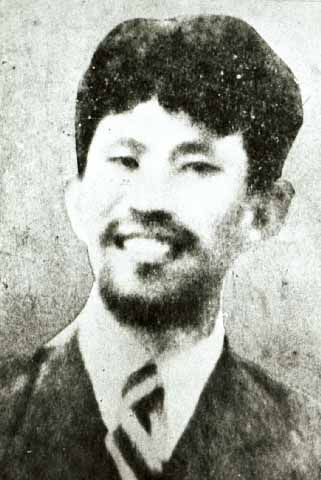
Yi Sang (August 20, 1910 - April 17, 1937) is considered one of the most innovative writers in modern Korean literature. Crossing and blurring the boundaries between poetry, fiction and essay, his experiments in literary form and language, as well the psychological complexity of his inquiry into passion, eroticism and the indeterminate nature of self were unprecedented in Korean literary practices of his time. (From Wikipedia)
I tried to find the best English-translated version of his poems, but with much respect, I couldn't. Therefore, I decided to post one of his less-language-oriented poem.
오감도 시제4호
환자의 용태에 관한 문제.
ㆍ0987654321
0ㆍ987654321
09ㆍ87654321
098ㆍ7654321
0987ㆍ654321
09876ㆍ54321
098765ㆍ4321
0987654ㆍ321
09876543ㆍ21
098765432ㆍ1
0987654321ㆍ
진단 0 : 1
- 26.10.1931
- 이상 책임의사 이 상
-
- (Korean Version)
-
-
- Crow's-Eye View: Poem No.4
-
- On The Issue of a Patience's Case
- ㆍ09876543210ㆍ98765432109ㆍ87654321098ㆍ76543210987ㆍ65432109876ㆍ54321098765ㆍ43210987654ㆍ32109876543ㆍ21098765432ㆍ10987654321ㆍDiagnosis 0 : 126.10.1931Overall Responsible Physician Yi Sang(Imperfect Englsih Version)
Subscribe to:
Posts (Atom)